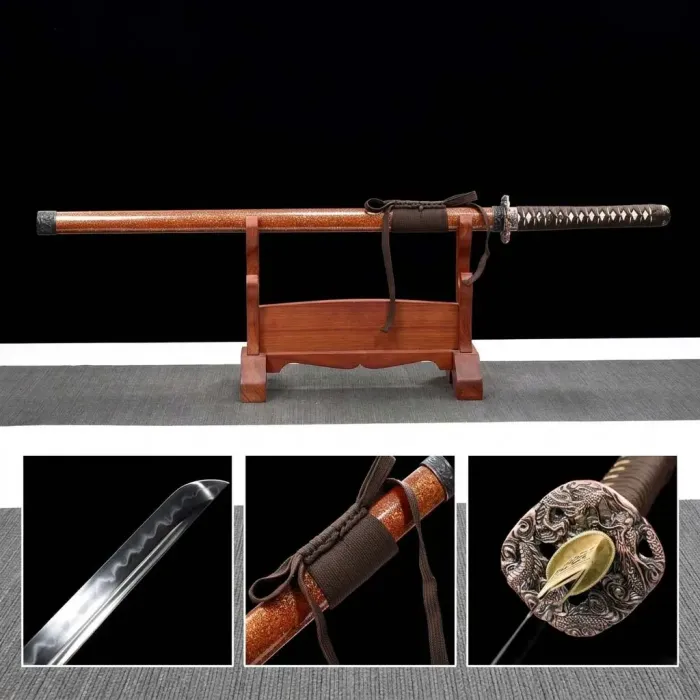
That conventional eastern blade stands a magnificent example of fabrication, but how about you strive for to show your own style? Personalizing your gear is a profound journey, allowing you to assemble a truly exceptional piece. From the grasp wrapping and collar to the shield design and temper line, each part offers a chance for unique expression. This survey delves into the world of katana customizations, providing tips for both newcomers and proficient enthusiasts desiring to make their footprint on the classical art of the samurai.
Newcomer's Legitimate Mastery
For those hoping to embark on the enriching journey of traditional blade practices , 1060 steel katanas deliver an prime entry point. This specialized grade of structural steel achieves a ideal mix between low price and quality . While not quite as hard as superior-grade steels, 1060 grants a moderate level of sharpening , making it appropriate for learners to develop the rudiments of sharpening care and respect the attractiveness of authentic Japanese weaponry. It’s a wonderful choice for developing experience without the investment burden of more specialized steels.
T-10 Steel Edges : Striking Efficiency and Budget
Providing for fans seeking an authentic weapon experience without surpassing the monetary limit , T10 material katanas represent a appealing option. These armaments offer a marked improvement in resilience compared to less expensive alternatives, exhibiting good edge retention and sufficient flexibility for rudimentary slashing techniques. While not rivaling the eminent characteristics of advanced steels like T100 or folded material , T10 provides a worthwhile blend of performance and value , making them a well-liked choice for rookies and those on a small financial .
Past the Metal: Refining Your Armament's Adornments and Tsuka
Considering the finished sword is undeniably the central point of a katana, truly heightening its appeal lies in the thoughtful customization of its features and haft . This art allows individuals to exhibit their distinct character. Review the wide possibilities: menuki - decorative trinkets that provide visual allure ; the hamon shields – often artistically carved ; the tsuka core itself, wrapped in time-honored ito braid ; and the fusa stopper , which can be made from various matter like alloys or shell .
- Pick patterns that harmonize with you.
- Delve into with assorted mediums.
- Highlight merit for a permanent result .
The Love of the Katana: Antiquity, Formation, and Composition
The oriental cutlery shows a special allure, steeped in periods of Pacific Rim history and custom . More than merely a device of skirmishing, it's a representation of the fighter ethos – a fusion of competence and discipline . Its advancement spanned countless generations, with early arms evolving into the elegant curvature and fatal edge we distinguish today. The construction involved is truly extraordinary , requiring long periods of instruction to achieve . The process involves a complex folding of forged iron , creating layers that boost the steel’s flexibility and cutting ability. Various schools of blacksmithing started , each with their distinctive secrets and practices for achieving the flawless balance and sharpness - a truly arduous pursuit.
- Primitive Katana models
- The significance of the cutting armament in knight culture
- Conventional manufacturing practices
Identifying the Fitting Steel for Your Weapon Project: 1060 vs. T10
Choosing the correct steel is absolutely important for any katana project, and the decision between 1060 and T10 can be tricky. 1060 is a frequented American element, offering a competent balance of rigidity and endurance, supplying it reasonably easy to forge. However, T10, a East Asian steel, commonly boasts improved wear longevity and can possibly achieve a higher final hardness, although it can be relatively laborious to control and requires meticulous heat conditioning. Consider your skillset and desired goals: for a learner, 1060 may be a clearer basis, while the skilled smith might appreciate the expanded traits of T10.
- Effortlessness of Processing
- Edge
- Terminal Firmness
Achieving Mastery: Complex Katana Adjustment Techniques
Advancing competence in blade refinement extends far beyond basic honing. Serious dedicated users are now studying advanced techniques to truly liberate a blade's hidden potential. This incorporates intricate work with the blade border, utilizing specialized compounds for differential annealing and carefully identifying the profile of the hilt guard to optimize balance and efficiency. Beyond purely functional enhancements, artisans are increasingly focused on reaching unparalleled aesthetic beauty, through complex cutting and layered surfaces that truly transform a katana into a artistic composition.
Forging a 1060 Katana: From Raw Metal to Masterpiece
The journey originates with conventional 1060 alloy , a robust material far removed the ornate katana it will change . Talented bladesmiths apply a multifaceted process of combining and fabricating the custom katana crude steel, repeatedly annealing it and hammering it to clear impurities and fashion a even grain structure. This tiring process, often enduring for stretches , builds the important toughness and malleability characteristic of a standard Japanese weapon . Supplementary heat treatments , including controlled hardening and curing , are critical to achieve the specific symmetry of sharpness, robustness and beauty .- Stacking: Lowers impurities and establishes grain structure.
- Shaping: Designs the steel into the initial blade form.
- Curing: Regulates the final hardness and flexibility.
The Continuing Pull of the Katana: Comprehensive Review of Metalwork and Tailoring
Each established katana remains a captivating symbol representing Japanese civilization , its magnetism far outstripping mere weaponry . Forged from tamahagane steel and frequently featuring intricate embellishments , the practice of creation itself is a esteemed art. Beyond the crucial craftsmanship, the ability to alter a katana - from the edge marking to the hold wrapping and fastening - facilitates for a wholeheartedly individual expression for both collectors and practitioners alike. This combination of historical steelwork and boundless personalization contributes the katana's continued popularity across the globe .